AI and B2B Sales
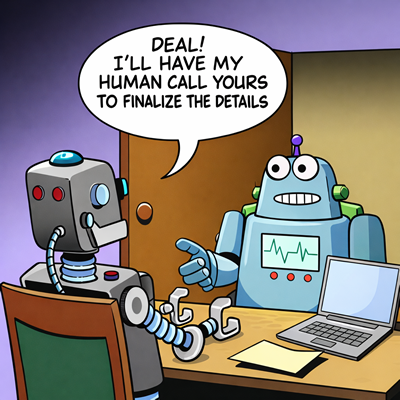 In the B2B world—and even more so in enterprise sales—the same question keeps coming back: with AI, do we still need experienced salespeople? At first glance, the argument seems solid.
Today, AI can:
- analyze complex organizations,
- map strategic accounts,
- identify weak buying signals,
- prepare highly structured sales arguments,
- automate a large part of the upstream sales cycle (MQL, SQL, etc.),
- handle parts of the customer relationship through agent-based systems.
In simple, transactional sales, the conclusion is clear.
AI is already replacing part of the sales work. But enterprise B2B sales follow very different rules.
What AI does extremely well in B2B sales
In mature organizations, AI becomes a powerful accelerator:
- - fine-grained qualification of strategic accounts,
- - analysis of negotiation history,
- - support in preparing complex meetings,
- - modeling price / margin / risk scenarios,
- - helping prioritize sales efforts.
In other words, it strengthens rigor, preparation, and sales discipline. But it does not sell on your behalf.
Where enterprise sales remains deeply human
An enterprise sale is never a purely rational decision. It is an unstable balance between:
- - internal political stakes on the client side,
- - implicit power dynamics,
- - personal risks for decision-makers,
- - long and often shifting timelines.
In a client executive committee, the final decision is rarely made on a slide or an algorithm.
It is driven by:
- - the salesperson’s personal credibility,
- - their ability to build trust over time,
- - their capacity to say no without breaking the relationship,
- - their ability to read what is never written.
AI does not doubt. It does not hesitate. It does not take responsibility. And enterprise sales is precisely about taking responsibility.
The real risk for B2B organizations
The danger is not that AI will replace salespeople. The danger is continuing to use salespeople as if AI did not exist.
The profiles most at risk are those who:
- - simply execute a process,
- - live inside the CRM without understanding the client’s strategy (assuming the CRM is even properly used!),
- - negotiate on price because there is no perceived value.
In this context, AI acts as a brutal revealer.
The enterprise salesperson of tomorrow
With AI, the enterprise B2B salesperson becomes:
- - less an information producer,
- - less a pipeline manager,
- - and much more a strategic player.
Their role shifts toward: orchestrating stakeholders, co-building complex value propositions, high-stakes negotiation, aligning customer needs, pricing, risk, and profitability.
This is not a disappearance. It is a rise in expectations.
In your B2B organizations, are you using AI to replace salespeople… or to finally allow them to play their true role?
Laurent van Hamme